--
DAYS
Innovation Makeathon
INNOVATIONDESIGNEXECUTIONADAPTABILITYTECHNOLOGYENTREPRENEURSHIP
CDE INNOVATION CHALLENGE · 10-WEEK MAKEATHON · OPEN TO ALL NUS UNDERGRADUATES
Countdown to launch day
01 ABOUT IDEATE
IDEATE is part of the CDE Innovation Challenge: a 10-week makeathon that invites NUS students from every discipline to identify a real-world problem and build a working prototype.
Participants will form a team, pass a preliminary design review, and prototype through recess week with industry mentors. Teams that make the final six after exhibiting at the semi-finals will then pitch for a share of the prize pool on the finals stage.
We're after mechatronic systems that interact with the physical world: solutions combining mechanical, electronic and software components to do something tangible. App-, website- or AI-only solutions will be marked down on innovation. VR counts if it includes physical interaction hardware like controllers or sensors.
The concepts below are illustrative examples, not past submissions.
Collapsible cookware and foldable panels that let people cook safely when the grid or fuel supply fails.
Sensors, filtration and automated valves that switch a home between rainwater, greywater and mains supply.
Phase-change materials and temperature-sensitive vents that keep a work surface comfortable without aircon.
02 TIMELINE
Ten weeks, nine checkpoints. Three workshops are compulsory for every team, and at least two members from each team must attend at least three technical workshops during recess week.
Opening ceremony with opening speeches, the challenge brief, rules, and your first compulsory workshop. Lunch and networking.
Lecture by Prof Khoo Eng Tat, a panel discussion, and a hands-on problem-solving session, with NUSOne and NUS Enterprise.
A 1–3 minute video: your problem statement, lo-fi prototype and rationale. Weighted 40% design, 40% engineering, 20% business.
Judges shortlist 16 of the 60 teams to advance to the prototyping stage.
Build your working prototype. Book sessions with student mentors, virtually or in person, whenever you need them.
Recess-week skills sessions organised by the Engineering Design and Innovation Centre: machining, PCB design, 3D printing, CAD, soldering and more. See the full list.
Send a 100-word project summary, then meet your industrial mentor for a consultation on feasibility, rigour and showcase readiness.
Pitch structure, storytelling and demo prep ahead of the finals.
Sixteen teams exhibit science-booth style; six judges pick the final six. Those six deliver a 5-minute business pitch plus Q&A to a panel of three. Audience members also stand to win prizes in a lucky draw.
Top three teams receive their prizes on the Innovation Day stage.
03 PRIZES + OPPORTUNITIES
Prototyping budget of S$1,000 for those who enrol in CDE3301 or CDE4301. Students who demonstrate a high level of performance will also be recommended for NUS Overseas Colleges (NOC).
04 WORKSHOPS + VENUES
Empathise, define, ideate, prototype, test. Introduction to sustainable design principles and the jobs-to-be-done framework.
COMPULSORY LT7A, BLK EA
A lecture on the innovation mindset by Prof Khoo Eng Tat, followed by a founder panel and hands-on problem-solving activities with NUSOne and NUS Enterprise.
COMPULSORY VENUE TBC
How to structure and deliver your finals pitch.
COMPULSORY VENUE TBC
Hands-on workshops organised by the Engineering Design and Innovation Centre. At least two members from each team must attend at least three. Sign-up priority for IDEATE participants.
Turn shafts, pins and cylindrical parts on the workshop lathe.
Cut slots, faces and holes with precision milling.
Design your own circuit board and take it through fabrication.
Set up ultra-wideband links for precise positioning and comms.
Build interactive VR applications in the Unity engine.
Rapid-prototype parts and enclosures in the makerspace.
Shape plastic casings, panels and housings for your build.
Model parts and assemblies in parametric CAD.
3D modelling and rendering with AI-assisted workflows.
Build a serverless voice application on AWS.
Through-hole and surface-mount soldering done properly.
Design collaboratively in cloud-based CAD, as a team.
MIN. 2 PER TEAM · 3 SESSIONS INNOVATION & DESIGN HUB (EA) + ELECTRONICS STUDIO (E2A) TENTATIVE · SUBJECT TO CHANGE
05 JUDGES + MENTORS
Semi-finals will be assessed by six judges with an engineering focus, and finals by three judges with a business focus.
SEMI-FINALS JUDGE
REVEALING SOON
SEMI-FINALS JUDGE
REVEALING SOON
FINALS JUDGE
REVEALING SOON
FINALS JUDGE
REVEALING SOON
Consultation slots can be booked throughout the prototyping phase, virtually or in person, for help with design and engineering decisions.
Past IDEATE winners and industry professionals. Each semi-finalist team must attend one compulsory consultation between 28 Sep and 4 Oct.
Prototype in the Innovation & Design Hub and Electronics Studio, with full makerspace access throughout the challenge.
06 PAST WINNERS + GALLERY
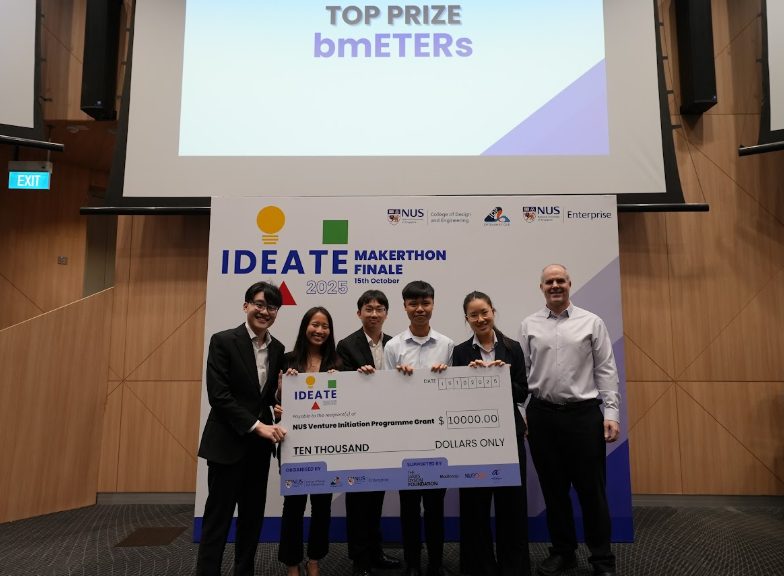 IDEATE 2025 · CHAMPION
An intelligent compression sock for lymphedema patients. It uses predictive technology to activate targeted compression only when the user actually needs it, resolving the discomfort of traditional constant-pressure garments.
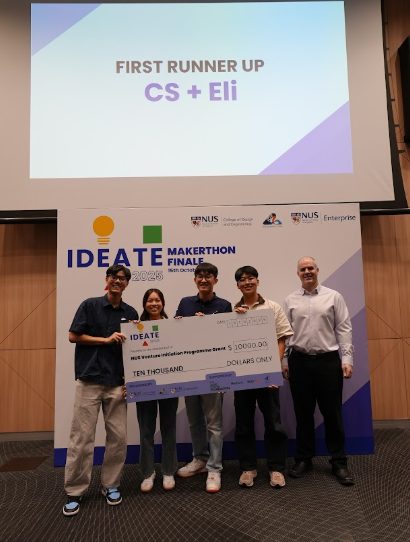 IDEATE 2025 · 1ST RUNNER-UP
A digital health platform built jointly by Psychology and Computing students, making mobility risk assessment safer and far more accessible for elderly adults and their caregivers.
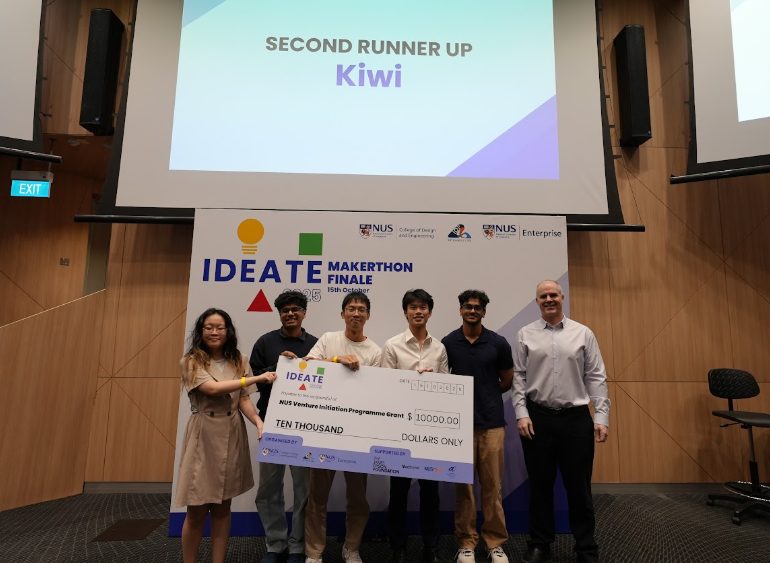 IDEATE 2025 · 2ND RUNNER-UP
An interdisciplinary system spanning Medicine, Computing, Mechanical and Electrical Engineering, designed to close functional gaps in medical emergency training protocols.
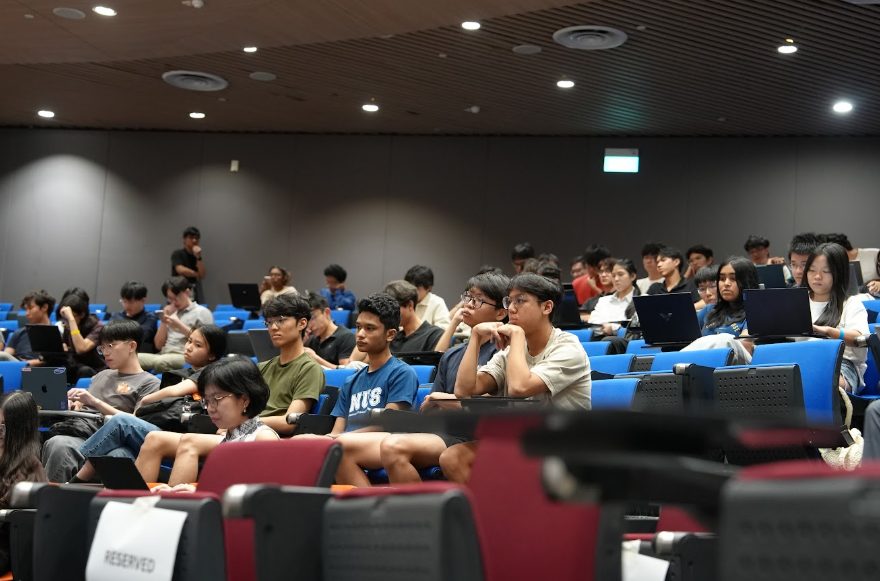 FIG. 01 — LAUNCH DAY, 2025
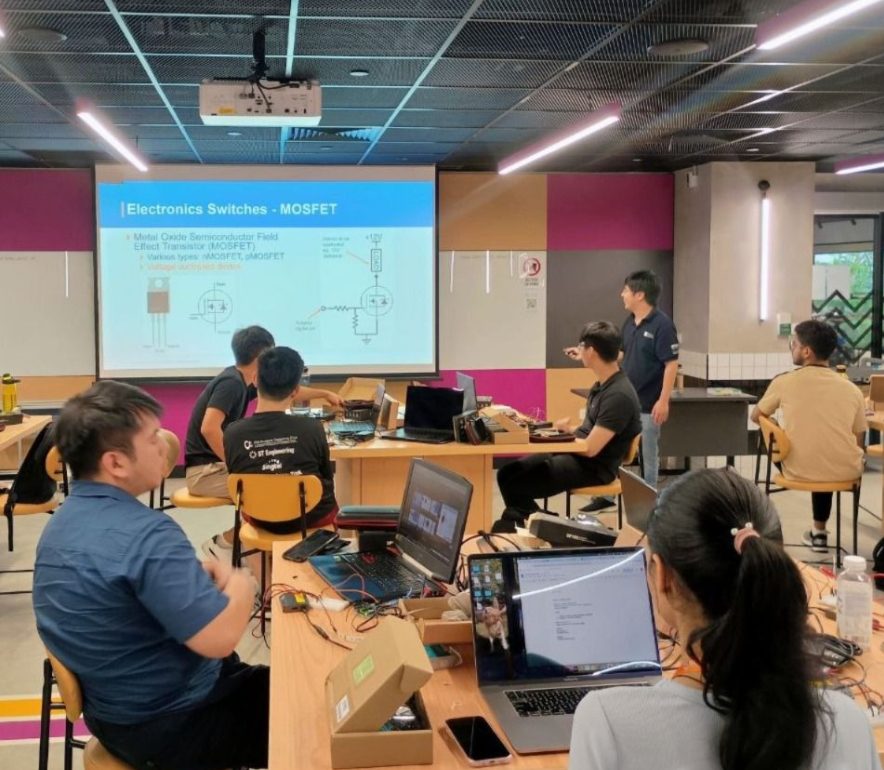 FIG. 02 — PROTOTYPING WORKSHOP
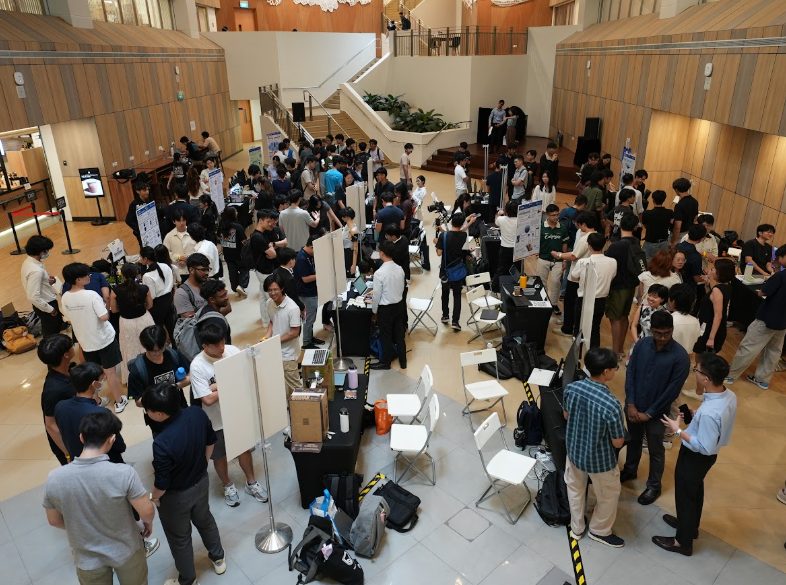 FIG. 03 — SEMI-FINALS EXHIBITION
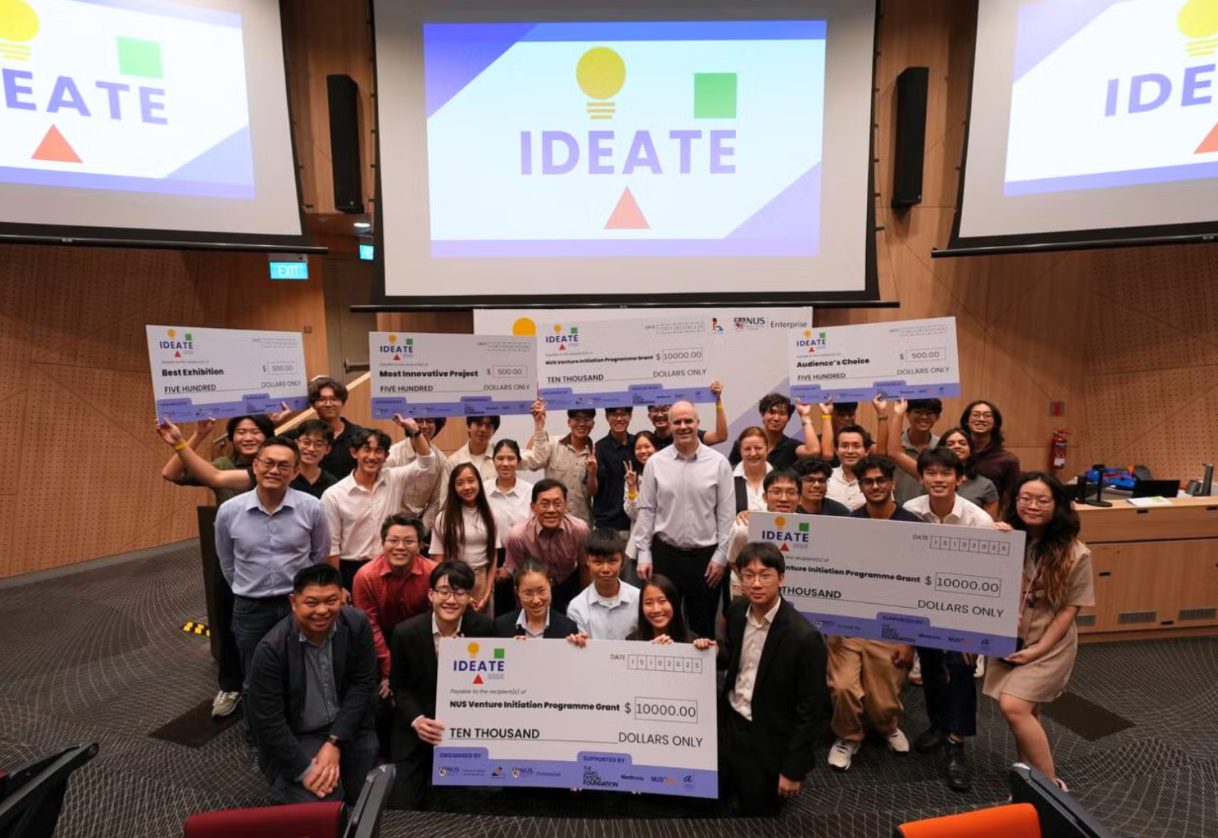 FIG. 04 — FINALS PITCH, 2025
07 FAQ
IDEATE is designed primarily for Year 1 and Year 2 NUS undergraduates, from any faculty or discipline. Undergraduates in other years are welcome to take part but are not the primary target audience. Interdisciplinary teams are highly encouraged!
Teams must consist of 3 to 5 members. All members must be NUS students.
No. The Innovation and Design Workshop on Launch Day helps you find and frame a problem, and the recess-week technical workshops cover skills from soldering to CAD to PCB fab. Cross-disciplinary teams are encouraged.
Participants are strongly recommended to create mechatronic system solutions that interact with the physical environment, combining mechanical, electronic and software elements.
Purely app, website, or AI-only solutions are not recommended and will be marked down on innovation. Your final project must involve a physical, high-fidelity prototype that can be demonstrated. Virtual Reality (VR) projects are allowed only if they include a physical interaction component, like custom controllers or sensors.
A 1–3 minute video submitted as a YouTube link by 30 Aug, covering your problem, user research, lo-fi prototype and rationale. It's weighted 40% design, 40% engineering, 20% business, and decides which 16 teams advance.
Yes. There are several compulsory workshops (the Innovation and Design Workshop on 15 Aug, Innovation Mindset on 19 Aug, and the Business Pitch workshop on 8 Oct) that require attendance. Additionally, during recess week, at least two members from each team must attend at least three technical workshops organised by the Engineering Design and Innovation Centre.
The 16 semi-finalist teams receive incredible perks, including an industrial mentor check-in, consideration for internship opportunities, a recommendation for the NUS Overseas Colleges (NOC) programme, and a S$1,000 prototyping budget if you enrol in specific CDE modules (CDE3301/CDE4301) — S$800 for non-iDP students.
The competition begins with up to 60 teams.
The format is a 5-minute pitch followed by 5 minutes of Q&A.
All on NUS Kent Ridge campus. See the map above.
08 ORGANISED + SUPPORTED BY



Organised by the Innovation and Design Programme, supported by the CDE Research and Technology Office and the James Dyson Foundation.